



Duplex ultrasound is an excellent and widely used technology. It provides valuable information about vessel anatomy, vessel patency, and blood velocity. It is very useful for assessing structure and function. The important distinction is that Duplex ultrasound and TTFM measure flow in fundamentally different ways.
Duplex ultrasound combines two types of information: a two-dimensional ultrasound image of the vessel and a Doppler measurement of blood velocity. Both are clinically useful. However, when Duplex estimates volume flow, it must combine these measurements with assumptions about the vessel.
Volume flow is three-dimensional. To calculate volume flow, three key pieces of information are needed: blood velocity, vessel size, and vessel shape. Doppler provides velocity. Ultrasound provides a measurement of vessel size in two dimensions. Vessel shape, however, is not directly measured.
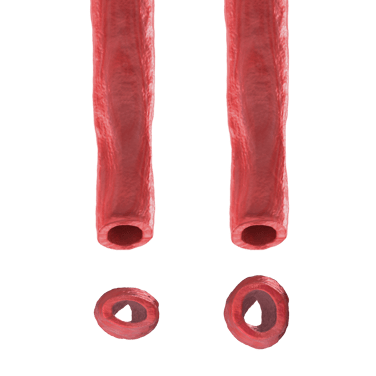 Because of this, Duplex systems typically calculate volume flow by assuming that the vessel is round and that the flow profile is predictable. In many clinical situations, vessels are not perfectly round, straight, or uniform. They may be compressed, curved, branching, or irregular in shape. These anatomical factors can influence the accuracy of calculated volume flow.
The illustration shows a common physiological scenario. Two vessels may appear to have a similar width when viewed from above, but if one vessel is out-of-round, it may carry a different volume of blood than expected from the two-dimensional image alone. In that situation, a calculated flow value will differ from the actual volume flow.
This does not reduce the clinical value of Duplex ultrasound. It simply highlights that Duplex estimates volume flow, while Transonic TTFM directly measures volume flow.
That is the key distinction.
TTFM is a direct, non-invasive intraoperative measurement of volume flow. When a direct volume flow measurement is available, it provides information that is not dependent on the same anatomical assumptions required for calculated flow estimates.
Thanks for reading,
Transonic Systems, Inc.
The Measure of Better Results